TalOS Robotics

Warehouse internal logistics · physics simulation

Humanoids at work in a warehouse, with real contact physics

Three warehouse scenes with Unitree G1 and H1 robots, stepped by the MuJoCo physics engine every millisecond. Nothing holds a robot: each stands on its own feet, and a whole-body controller sends its motors torques only. Every part is a free body held by the hands' contacts and friction, or it falls. Each frame is path traced from the recorded physics. No physical robot was commanded.

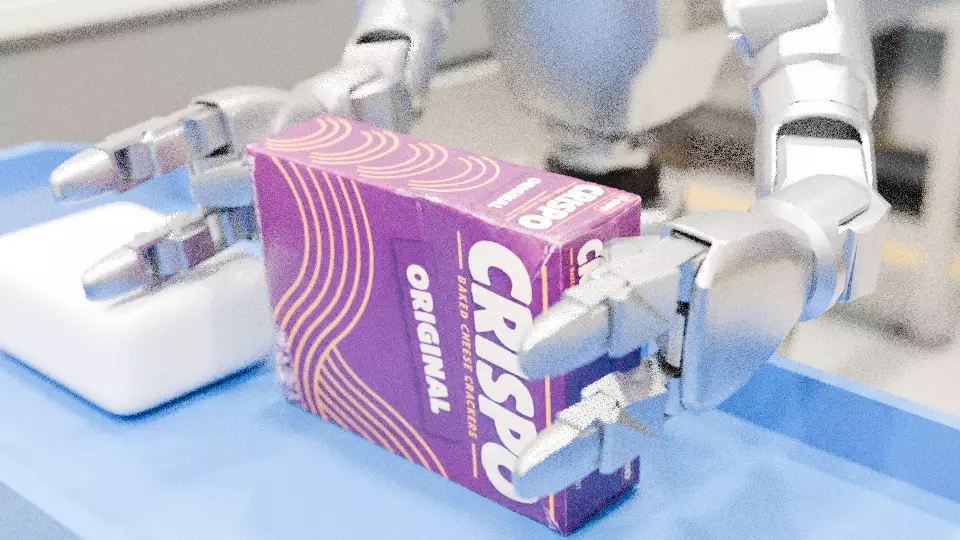
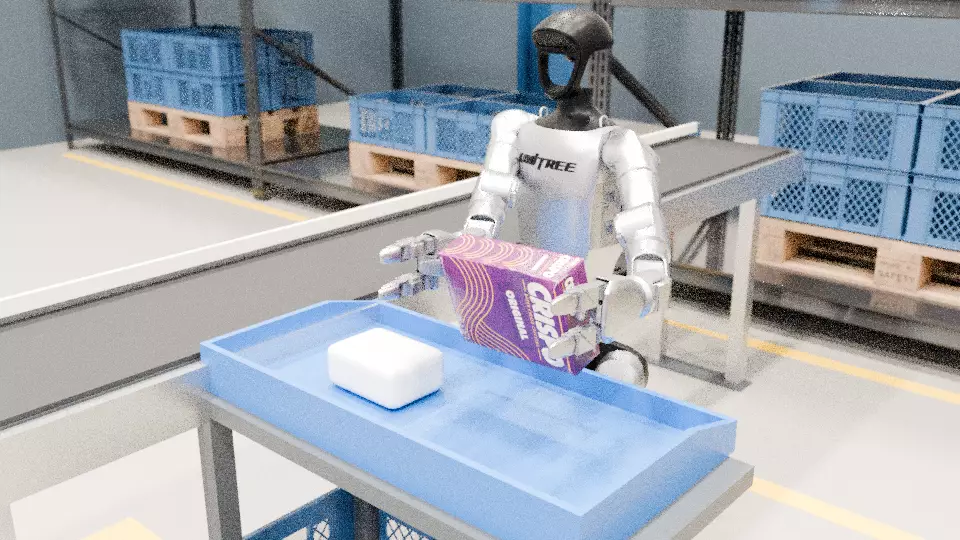
The free G1 presses a 411 g carton between its two palms by force and lifts it, at a quarter speed. The carton is held by the palms' contacts alone.

Scene 1 · MuJoCo · scripted controller

G1 tote picking

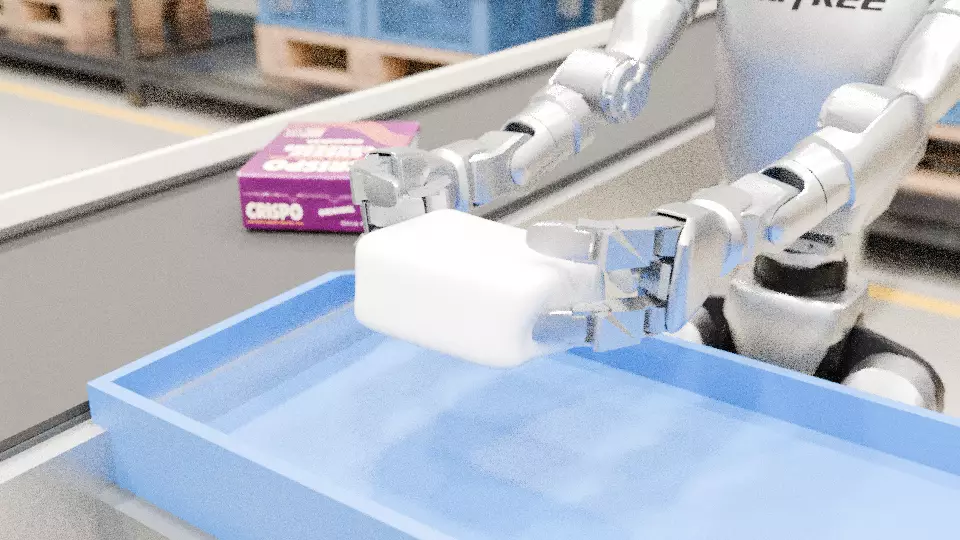
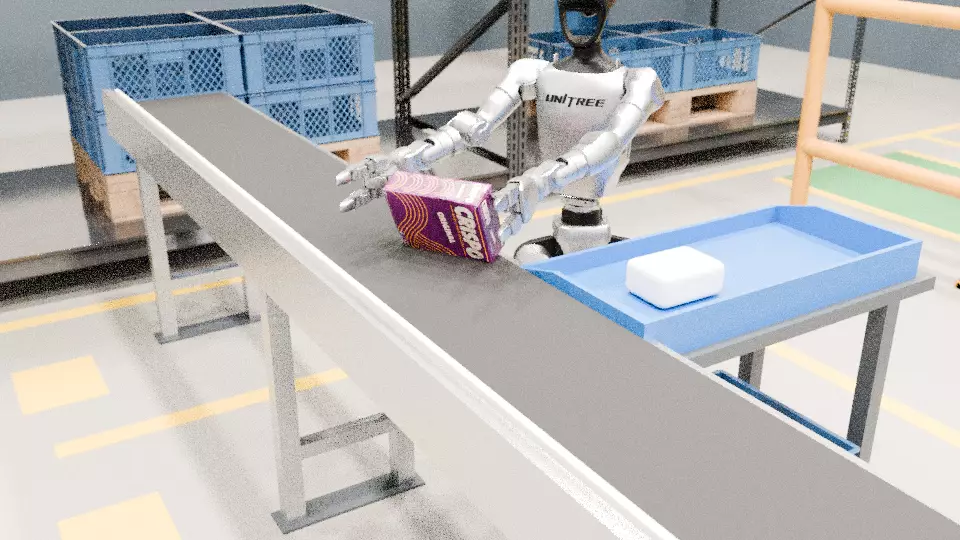
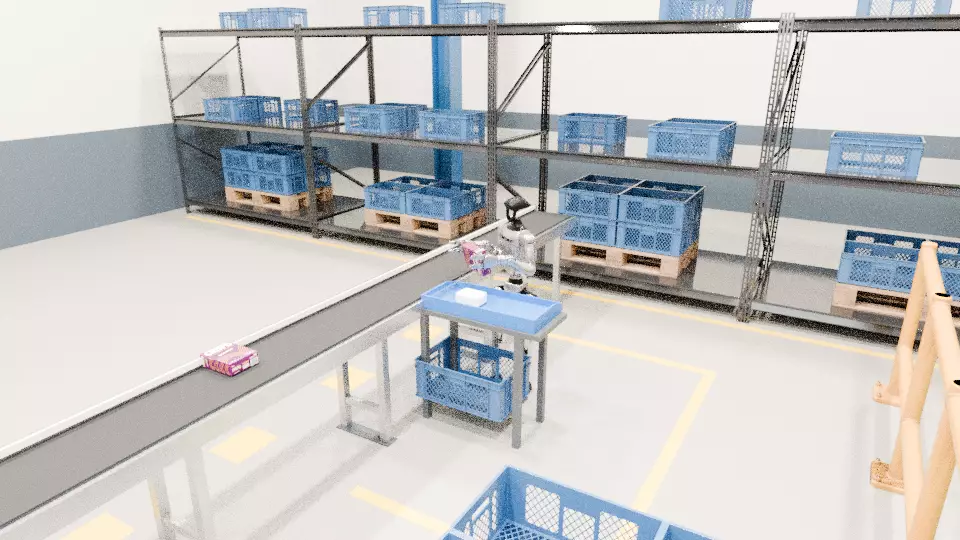
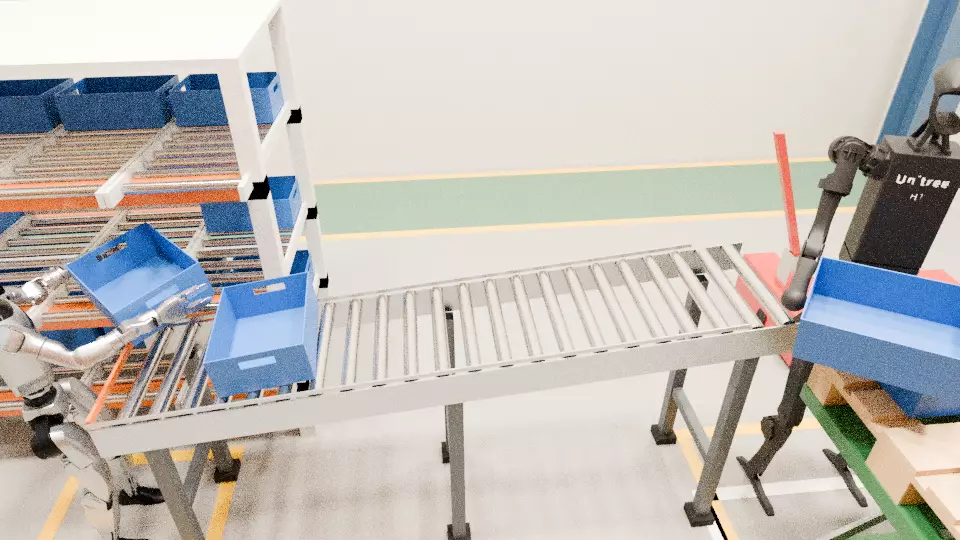
A free G1 with Dex3-1 hands presses a carton between its two palms, lifts it out of a picking tote, turns 60 degrees (on its feet and at the waist) and sets it on the takeaway belt. Then it crouches over a soft pouch, wraps its ends in its curled fingers, lifts it and carries it straight across to the belt.

Measured in the run: the carton's grasp was force-closed on the first try; it held through the lift, the carry and the set-down (it moved 6.7, 11.4 and 0.4 mm against the hands) and ends on the belt. The soft pouch was lifted 114 mm and held through the lift, the carry and the set-down (its nodes' centre moved 16.9, 8.7 and 11.7 mm against the hands; it deforms as it is held) and ends on the belt. The G1 stood through the whole run (at most 2.9° of tilt).

Close: the palms press the carton and lift it.
Close: the fingers wrap the soft pouch's ends, and the G1 carries it to the belt.
The G1 lifts the carton out of the tray The G1's palms pressing the carton's ends The G1 lifts the soft pouch out of the tote The carton on the belt Wide view of the bay with racking and the conveyor

Scene 2 · MuJoCo · one bin, the H1 alone

The H1 at the hand-over station

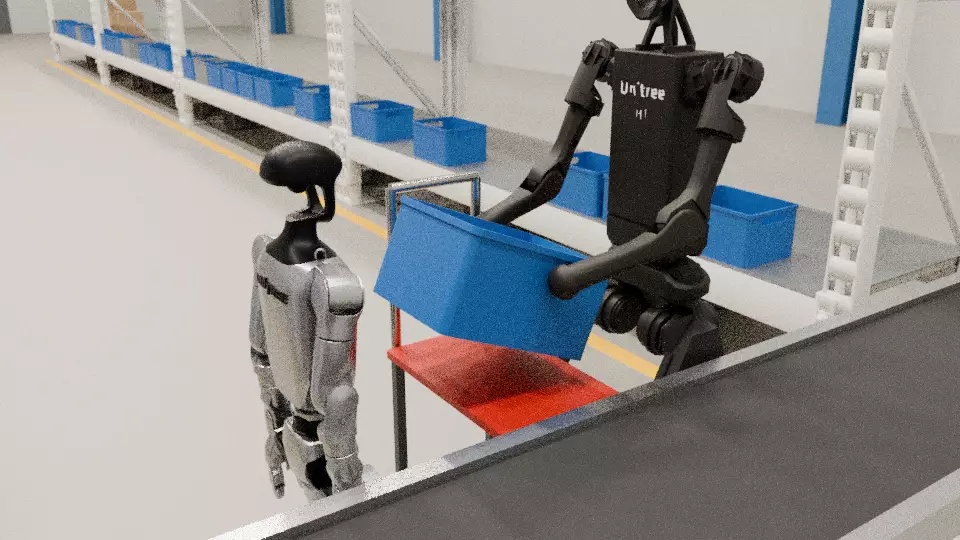
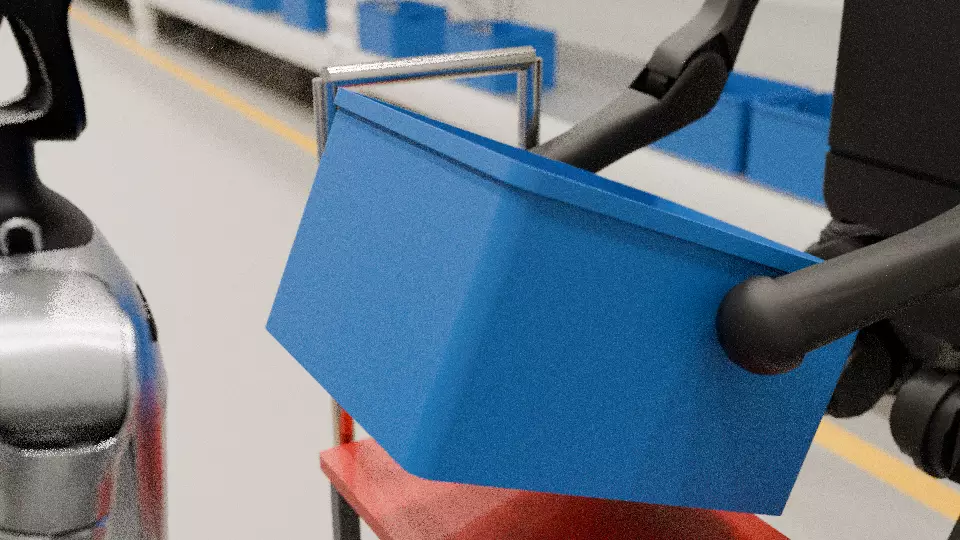
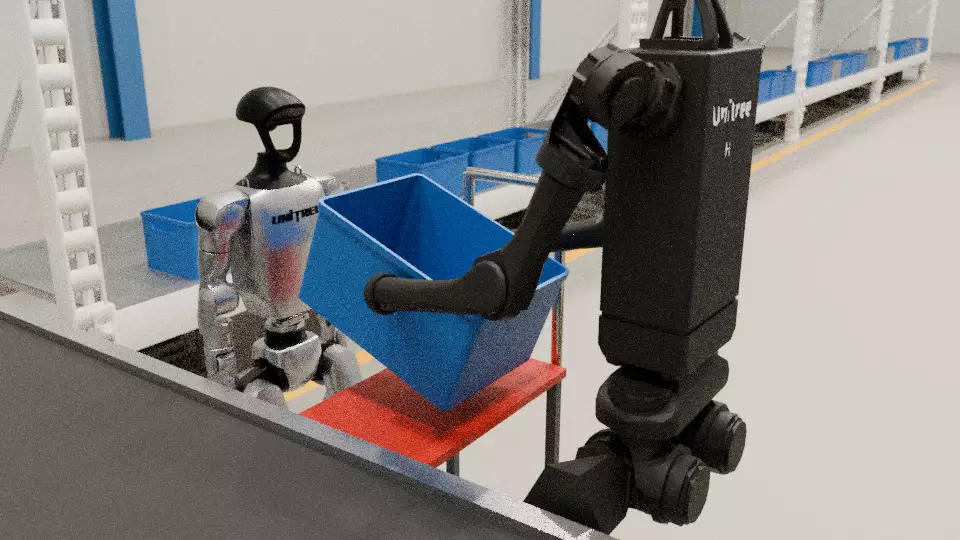
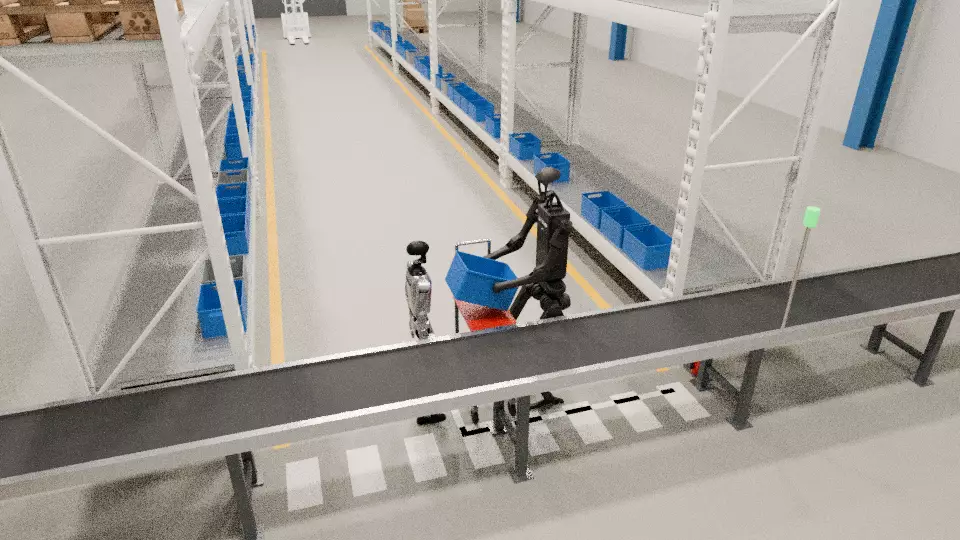
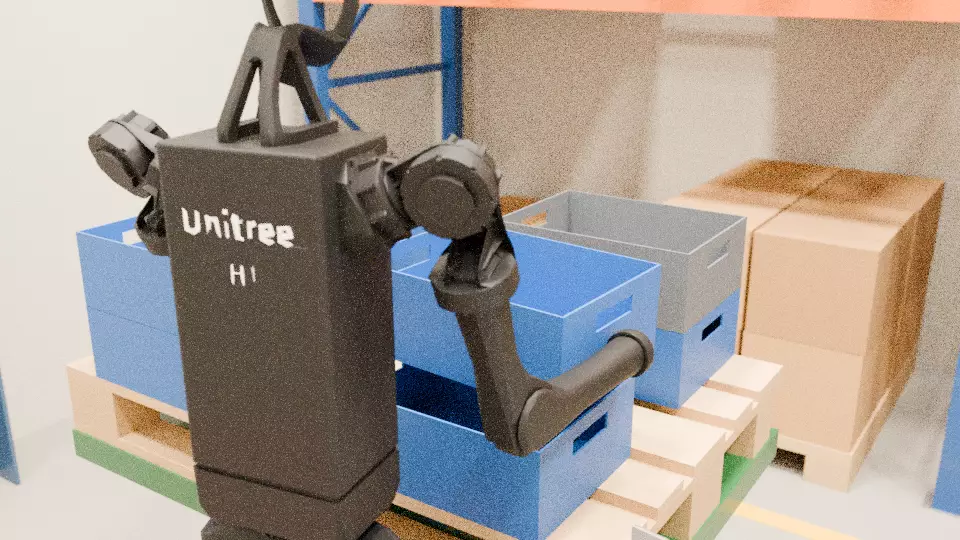
In an aisle by the cross conveyor, a free H1 presses a 1.5 kg KLT bin's long walls between its ball hands, across the bin's centre of mass, lifts it off its cart, holds it and sets it back. A free G1 stands by.

Measured in the run: lifted 118 mm and held through the lift and a 2 s hold (it moved 7.4 and 4.8 mm against the hands); it ends on the cart. Both robots stood throughout. The two robots do not lift the bin together: closing on it at the same time, they pushed it between them; coming in to the bin the H1 held, the G1's palms stopped short of its walls. The H1 was to walk the bin to the conveyor; that is not done either (see What this is).

Close: the H1's ball hands on the bin's walls, and the lift.
The H1's lift at a quarter speed.
The H1 holds the bin above its cart The H1's ball hands on the bin's walls The bin held by the H1, from its side The aisle with both robots, racking and a forklift

Scene 3 · MuJoCo · scripted controller

Depalletising and kitting

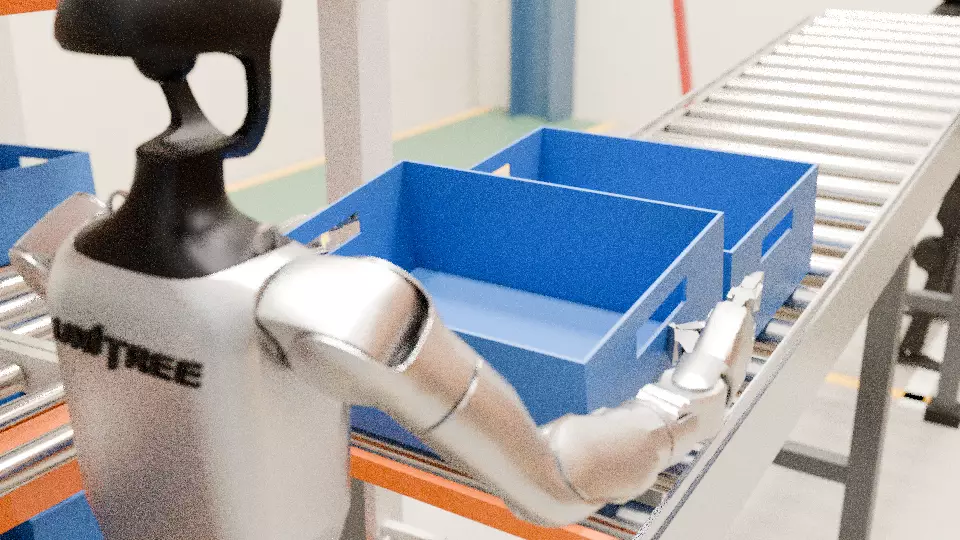
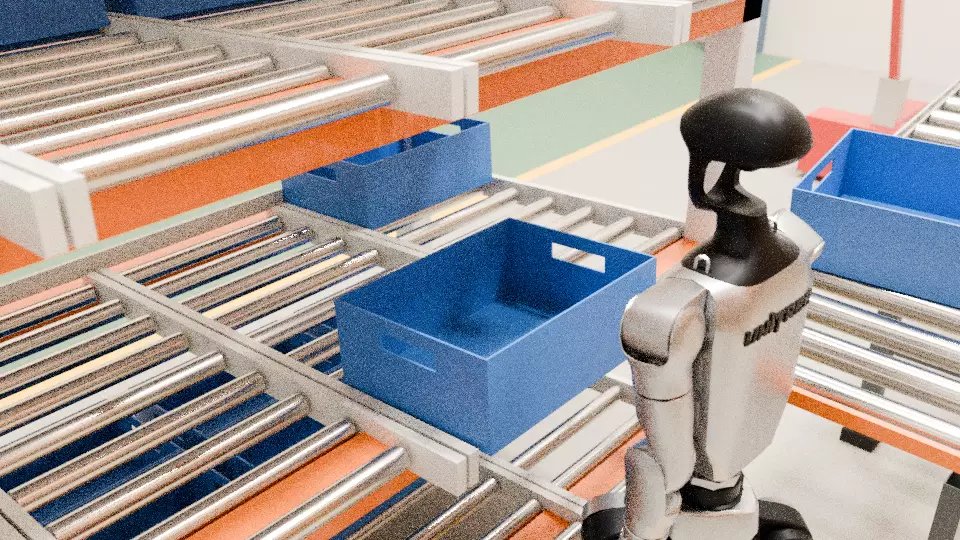
A free H1 squeezes a KLT tote off a pallet on a lift table between its forearms, a line of contact along each end wall, turns a quarter at the waist and sets it on a gravity conveyor. At the conveyor's stop, a free G1 presses the waiting tote between its palms, turns a quarter (45 degrees on its feet, the rest at the waist) and sets it on a lane of a carton-flow kitting rack, its centre on the lane's centre line (the lane is 408 mm between its rails for a 400 mm tote).

Measured in the run: both grasps were force-closed on the first try. The H1's tote held through the lift, the quarter turn and the move over the conveyor (1.3 to 3.9 mm against the forearms) and ends on the conveyor, which takes it downhill. The G1's tote held through the lift, the turn and the set-down (0.6 to 1.7 mm) and ends on the lane's wheels. Neither robot fell.

Close: the G1's palms on the tote's walls.
Close: the H1 squeezes the tote off the pallet.
The whole line from the pallet to the kitting rack The G1's palms on the tote at the conveyor's stop The H1 lifts a tote off the pallet The tote on the flow-rack lane

What this is

Simulations, not recordings. These are simulations of warehouse tasks with Unitree robots (G1, H1), shown as robots that TalOS-style software could run. They are not TalOS's robots, and they are not recordings of TalOS's software in use. No physical robot was commanded, and the scenes show no real-world result.

Physics, every frame. MuJoCo 4.0.0 steps each scene every 1 ms (the discrete integrator, elliptic friction cones, the Newton solver, impratio 10). The G1 is Unitree's model with two Dex3-1 three-finger hands (MuJoCo Menagerie, BSD-3-Clause); the H1 is Unitree's model with its ball hands (BSD-3-Clause). Links collide as the convex hulls of their collision meshes; the bins and totes as convex pieces (CoACD, MIT). The carton (411 g), the pouch (250 g), the bin (1.5 kg) and the totes (1.0 kg) are free bodies: nothing welds or parents them to a hand. The pouch is a deformable flex (Young's modulus 20 kPa).

Free robots, torques only. Nothing holds a robot: no fixed base, no weld, no position set by hand. Every motor is a torque motor within its joint's limit, and a robot moves only by those torques and its contacts under gravity. CommandAGI's whole-body controller solves one quadratic program at 500 Hz (task-space inverse dynamics on MuJoCo's own mass matrix and Jacobians, with ProxQP from proxsuite 0.8.2, BSD-2-Clause): it holds the equations of motion, the torque limits, the joints' ranges and the soles' friction cones, and weighs balance first, then the hands, then the posture. A hand's press is force control on the force its contacts report; before a lift a linear program (SciPy's HiGHS, BSD-3-Clause) checks the measured contacts for force closure, and a grasp that is not closed is taken again. Each program is scripted in its design, not learned.

Grasp trials. Each pick was run again with its part displaced 0 to 15 mm on its support (8 placements). A pick succeeds when every hold of it held (lifted 15 mm, under 15 mm of slip in the hands, 60 mm for the soft pouch, the hand touching the part) and the part ended on its place. On 8 November 2026: the carton 7 of 8, the soft pouch 7 of 8, the bin 8 of 8 (lifted by the H1 alone, not by two robots), the H1's tote 7 of 8, the G1's tote 8 of 8, and no robot fell in the 24 runs. The misses: the carton set on the belt's guide rail, the pouch released over the tote, the H1's tote on the pallet's next tote. The videos above are the trials' undisplaced runs. (On 7 November: the carton 4 of 8, the pouch 0, the bin 0, the totes 0 and 1; a robot fell in 12 of 24.)

Known limits. The H1 does not walk with a part. It walks under the same controller empty-handed, but a 1 kg tote between its ball hands was lost in the first steps of every gait tried (its own quick steps with 150 and 90 mm strides, with and without the load in its centre of mass, a slow weight shift, slower steps): with no ankle roll it shifts its weight only by stepping, and its body lunges 12 to 19 cm sideways in 0.3 s. So it turns at the waist instead. The two robots do not hold one part together. The conveyor's rollers and the rack's skate wheels are low-friction slopes, not turning wheels.

No generative model made any pixel. Each frame is path traced by CommandAGI's own renderer (Blender Cycles) from the recorded physics of a design written as code.

What the research showed, for scale. The research collaboration with TalOS (August to October 2026) was in simulation only. RRP, the relational robot policy, has not beaten plain behaviour cloning on a new body (0 of 200 zero-shot on a new arm), though it leads on the bodies it was trained on. Ψ0.1's pilot scored 19 of 20 against the Ψ0 behaviour-cloning baseline's 20 of 20. No learned policy moves the robots here.
Credits